
A blank page does not always mean a blank mind. Writers, artists, musicians, filmmakers, entrepreneurs, and other creative people often experience periods when ideas seem difficult to access. The instinct is usually to push harder. Think deeper. Research more. Stay at the desk longer. Sometimes that works. Mostly it creates even more internal noise.
Creative work requires effort, but it also requires flexibility. When attention becomes dominated by evaluation, expectations, repetitive thinking, or the pressure to produce something worthwhile, imagination may have less room to move. This is one reason hypnosis, guided imagery, mindfulness, NLP concepts, ego-state exploration, and intentional imagination can become useful tools within a broader Creative Flow practice.
Creativity Requires More Than One Type of Thinking
Creativity researchers commonly distinguish between divergent thinking and convergent thinking. Divergent thinking involves generating possibilities. Convergent thinking involves narrowing those possibilities, evaluating them, and deciding which direction is most useful. We need both. The problem often begins when we try to do both at the same time.
Imagine a writer developing a new character while simultaneously thinking:
- “Is this original?”
- “Will anyone like this?”
- “Has someone already done it?”
- “Is this good enough?”
The creative process quickly becomes an editing process. One of the most useful principles in creativity training is therefore simple: Generate first. Evaluate later. Hypnosis and guided imagery can help create a temporary mental space in which exploration becomes more important than immediate judgment.
What Does Hypnosis Have To Do With Creativity?
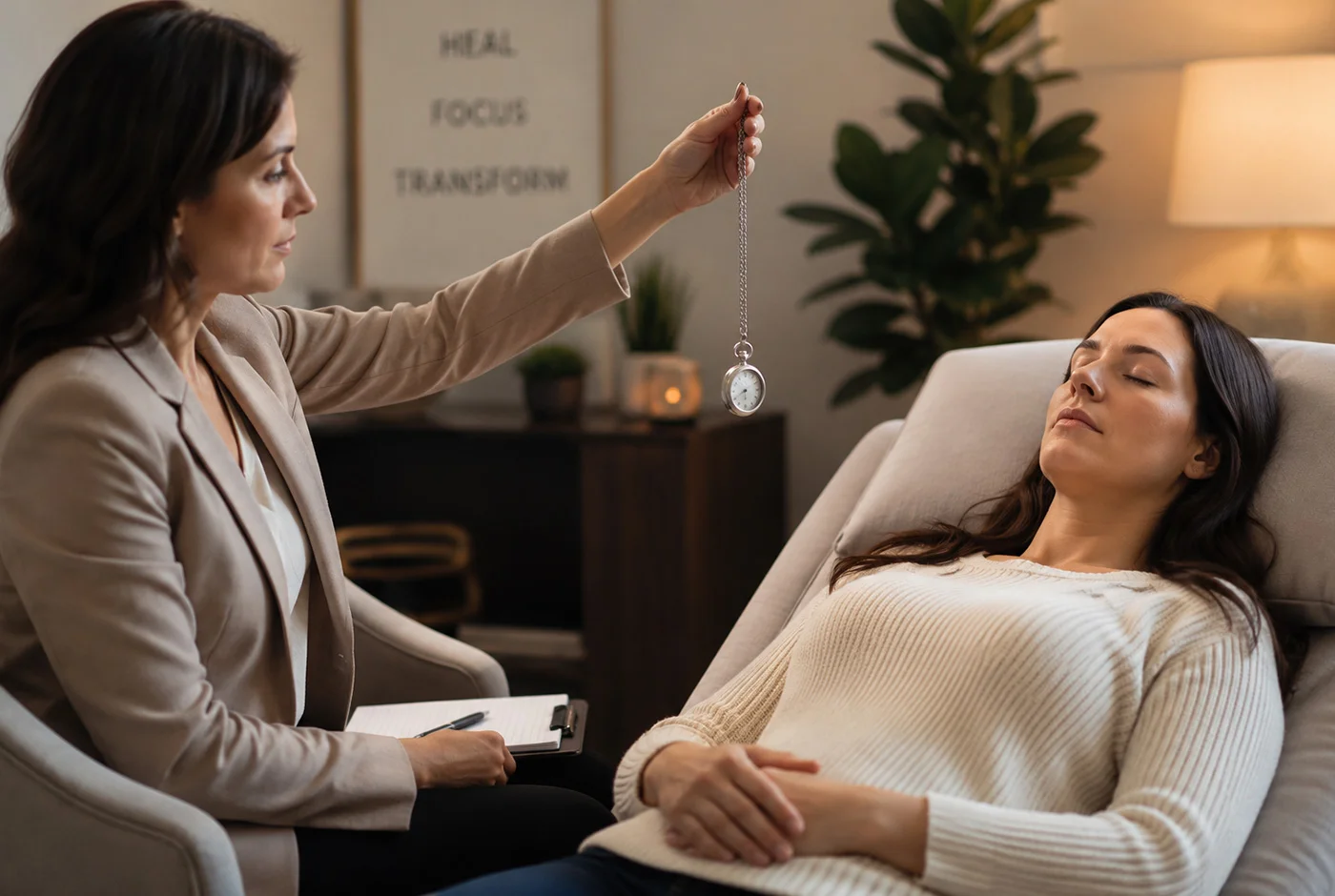
Hypnosis is often misunderstood because of its portrayal in movies, television, and stage performances. In contemporary usage, hypnosis is generally associated with focused attention, absorption, imagination, and responsiveness to suggestion. It does not require losing control or becoming unconscious. For creative work, the purpose is not to somehow place creativity into a person. The creativity is already theirs. Instead, hypnosis can be used as a structured way of shifting attention away from habitual evaluation and toward imagination, sensory experience, curiosity, and possibility.
A creative hypnosis exercise might invite someone to:
- Approach a familiar project as though seeing it for the first time.
- Allow several ideas to appear before selecting one.
- Temporarily suspend evaluation.
- Imagine a scene from an unexpected perspective.
- Mentally remove normal limitations.
- Reconnect with curiosity or creative excitement.
- Explore unusual associations without immediately deciding whether they are useful.
Most of the ideas that emerge may never be used. That is perfectly fine. The goal is not to immediately discover the right idea. The goal is to increase the number of possible ideas.
Guided Imagery Is More Than Seeing Pictures
Some people hear the term guided imagery and assume they must be able to visualize vivid pictures. That is not necessarily true. Imagery can involve sight, sound, movement, rhythm, texture, spatial relationships, conversation, physical sensation, or simply an internal sense of what something might be like.
A filmmaker might mentally walk through a scene from the perspective of each character. A musician might imagine how a melody would change if it represented a storm, a conversation, or a memory. A novelist might mentally enter a room occupied by a character and notice something that had never appeared in the written description. An entrepreneur might imagine a product several years into the future and then mentally work backward to identify what had to change.
These exercises force the mind to represent familiar material differently. And sometimes a new idea appears not because we discovered more information, but because we looked at existing information from a different angle.
Imagination as a Creative Laboratory
Imagination allows us to temporarily experiment without immediately dealing with practical limitations. Suppose you are developing a new project. Instead of asking: “How can I realistically improve this?” Try asking:
- “What would I create if money were unlimited?”
- “What would make this completely different?”
- “What would a child suggest?”
- “What would the opposite solution look like?”
- “What would happen if I removed the part everyone assumes is necessary?”
You may never use the answers. That is not the point. The exercise has already interrupted the most predictable mental pathway. Creativity often depends on giving the mind permission to travel somewhere unfamiliar before asking whether that destination is practical.
Reconnecting With Wonder
Another powerful Creative Flow exercise involves remembering a time when creativity was already naturally present. Think about a moment when you became completely absorbed in something. Maybe you were writing, drawing, performing, solving a problem, designing something, playing music, taking photographs, building something, or simply following an idea because it fascinated you. Instead of only remembering what happened, ask:
- What captured my attention?
- What was exciting about it?
- What possibilities seemed available?
- What was I not worrying about?
- Who was with me?
- What were my surroundings?
- How did it feel to become absorbed in the experience?
Then ask:
What quality existed in me then that I could bring into what I am creating now? Perhaps it was curiosity. Playfulness. Wonder. Boldness. Humor. Experimentation. The goal is not to recreate the past perfectly. It is to recognize that you already have a history of creative states and that aspects of those experiences may be intentionally revisited.
We Are Only Scratching the Surface
Hypnosis and guided imagery are not creativity shortcuts, and they do not guarantee inspiration on demand. They are meaningful tools. Used thoughtfully, they may help someone practice shifting attention, experimenting with perspective, accessing imagination, reducing premature evaluation, and reconnecting with qualities associated with previous creative experiences. And this is only a small part of what can be explored.
Creative Flow can also involve mindfulness, creative disruption, sensory exercises, perspective shifting, metaphor implementation, intentional daydreaming, self-hypnosis, personalized suggestions, creative routines, ego-state programming, illuminating obstacles to creativity and learning how to recognize your own individual patterns of inspiration and interference. There is much more beneath the surface than simply trying harder to “be creative.”
Ready to Explore Creative Flow More Deeply?
At Journey2Horizon, Creative Flow seminars, small-group programs, and individual sessions explore creativity as an active, experiential process. Programs may include hypnosis, guided imagery, mindfulness, ego-state work, imagination building exercises, perspective shifting, creative disruption, overcoming blocks to imagination, and other approaches designed to encourage curiosity, flexibility, and new possibilities. Individual sessions can also help participants begin identifying their own creative patterns and developing personalized approaches to Creative Flow.
This article is only an introduction. The deeper work begins when the techniques become personal. To learn more about upcoming Creative Flow programs or individual sessions, visit Journey2Horizon.com.
Journey2Horizon programs are educational, experiential, and personal-development oriented. They are not psychotherapy, counseling, diagnosis, or treatment of mental health conditions.